
 By admin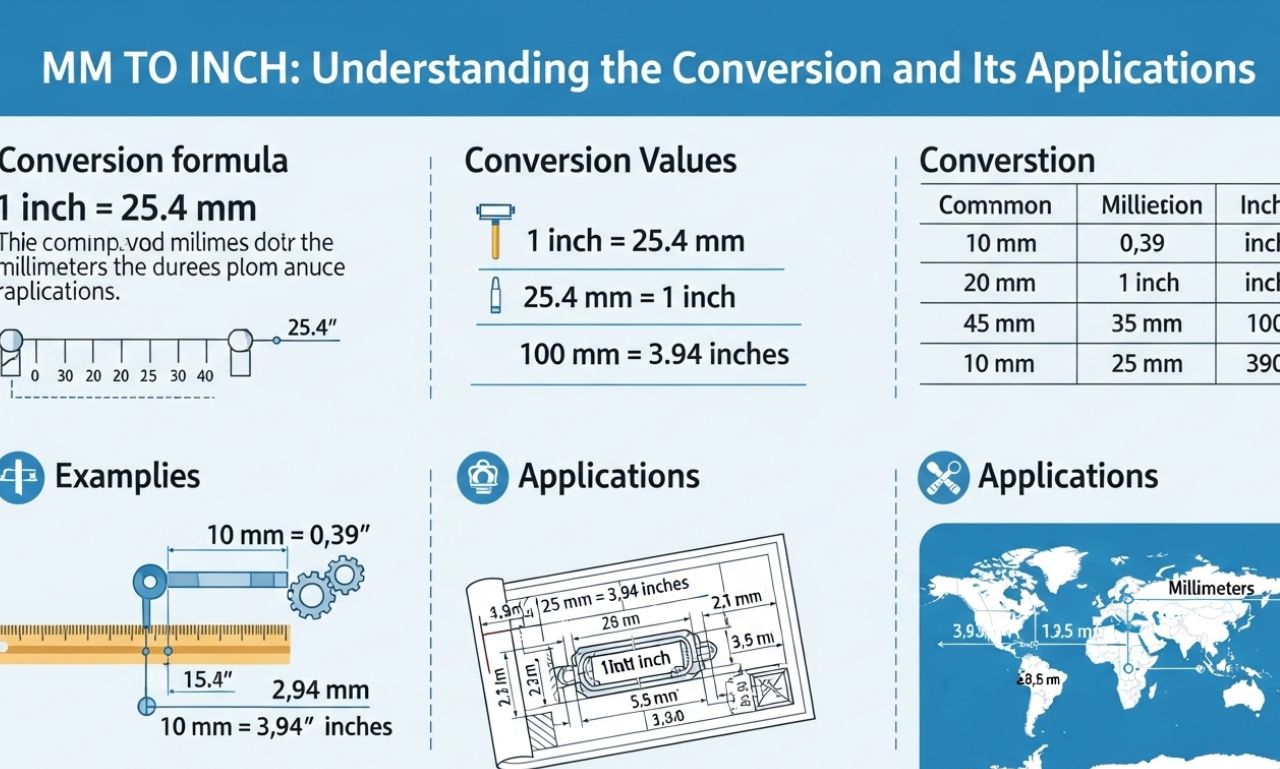
Converting mm to inch is a fundamental skill in various fields, from engineering and construction to crafting and tailoring. Millimeters (mm) and inches are two commonly used units of length measurement. While the metric system relies on millimeters, the imperial system uses inches. Understanding how to convert mm to inch ensures precision in projects and prevents costly mistakes. In this article, we will break down the conversion process, provide practical examples, and discuss its real-world applications.
What is a Millimeter?
A millimeter, abbreviated as mm, is a unit of length in the metric system. It is one-thousandth of a meter, making it extremely useful for measuring small distances or fine details. Millimeters are commonly used in:
-
Engineering and mechanical design
-
Manufacturing processes
-
Architecture and construction
-
Crafting and DIY projects
Understanding the size of a millimeter is essential before learning how to convert mm to inch, as it gives context to the measurements you are working with.
What is an Inch?
An inch is a unit of length in the imperial system. It is widely used in countries like the United States and the United Kingdom. One inch is equivalent to 2.54 centimeters or 25.4 millimeters. Inches are often used in:
-
Carpentry and furniture making
-
Screen sizes for televisions and monitors
-
Clothing measurements in certain regions
-
Engineering projects following imperial standards
Recognizing the value of an inch helps when converting mm to inch, especially for precision-based projects.
The Formula to Convert MM to Inch
Converting mm to inch requires a simple mathematical formula. Since 1 inch equals 25.4 millimeters, the formula is:
Inches=Millimeters25.4\text{Inches} = \frac{\text{Millimeters}}{25.4}
For example, to convert 50 mm to inch:
50÷25.4≈1.9685 inches50 \div 25.4 \approx 1.9685 \text{ inches}
Using this formula, you can convert any measurement from millimeters to inches with ease. Keeping a calculator handy is useful for exact conversions, especially in professional settings.
Step-by-Step Guide to Converting MM to Inch
Step 1: Identify the Measurement in Millimeters
Start with the measurement you need to convert. For instance, 100 mm.
Step 2: Divide by 25.4
Use the formula:
Inches=Millimeters25.4\text{Inches} = \frac{\text{Millimeters}}{25.4}
So,
100÷25.4≈3.937 inches100 \div 25.4 \approx 3.937 \text{ inches}
Step 3: Round Off If Necessary
Depending on the level of precision needed, round the result to the required number of decimal places. For general purposes, rounding to two decimal places is common:
100 mm ≈ 3.94 inches
Practical Examples of MM to Inch Conversion
Understanding the conversion is easier when you see practical examples:
-
Small Electronics: A smartphone screen of 145 mm width converts to 5.71 inches.
-
Home Improvement: A wooden plank 500 mm long converts to 19.69 inches.
-
Textiles: A fabric width of 1200 mm converts to 47.24 inches.
These examples show how mm to inch conversion is crucial in everyday measurements.
Tools to Convert MM to Inch
While manual calculations are straightforward, several tools make mm to inch conversion faster and more convenient:
-
Online Converters: Websites allow instant conversion without manual calculation.
-
Calculator Apps: Most smartphone calculators include a unit conversion feature.
-
Conversion Charts: Handy reference charts provide quick mm to i nch equivalents.
-
CAD Software: Engineering and design software automatically convert units during drafting.
Using these tools ensures accuracy and saves time in professional and personal projects.
Applications of MM to Inch Conversion
The need to convert mm to i nch spans multiple industries:
-
Construction: Ensuring materials fit precisely when using imperial or metric standards.
-
Engineering: Converting specifications from one system to another during international collaborations.
-
Manufacturing: Machines often require measurements in inches, even if the original design is in millimeters.
-
Crafting and DIY: Accurate measurements prevent mistakes and enhance product quality.
The ability to convert measurements efficiently is a valuable skill that reduces errors and ensures quality results.
Tips for Accurate MM to Inch Conversion
-
Use Precision Tools: For high-accuracy projects, use digital calipers or rulers with mm and inch scales.
-
Double-Check Calculations: Even a small error in conversion can cause significant problems.
-
Understand Decimal vs. Fraction Inches: Some projects require fractions of an inch, so convert decimals to fractions when necessary.
-
Keep Reference Charts Handy: Especially useful for quick conversions without relying on electronic devices.
By following these tips, converting mm to i nch becomes a seamless process.
Common Mistakes to Avoid
-
Assuming 1 mm ≈ 0.1 inch: This is a common approximation but inaccurate. Always use 25.4 mm per inch.
-
Rounding Too Early: Early rounding can compound errors, so round only at the final step.
-
Ignoring Measurement Type: Understand whether you need decimal inches or fractional inches for your project.
Being mindful of these mistakes ensures your mm to i nch conversions are precise and reliable.
Conclusion
Mastering mm to i nch conversion is essential for anyone working with measurements, whether in professional fields like engineering or everyday tasks like home improvement. By understanding the relationship between millimeters and inches, using accurate formulas, and employing reliable tools, you can ensure precise measurements and successful outcomes. With practice, converting mm to i nch becomes second nature, saving time, reducing errors, and enhancing your projects’ overall quality.