
 By admin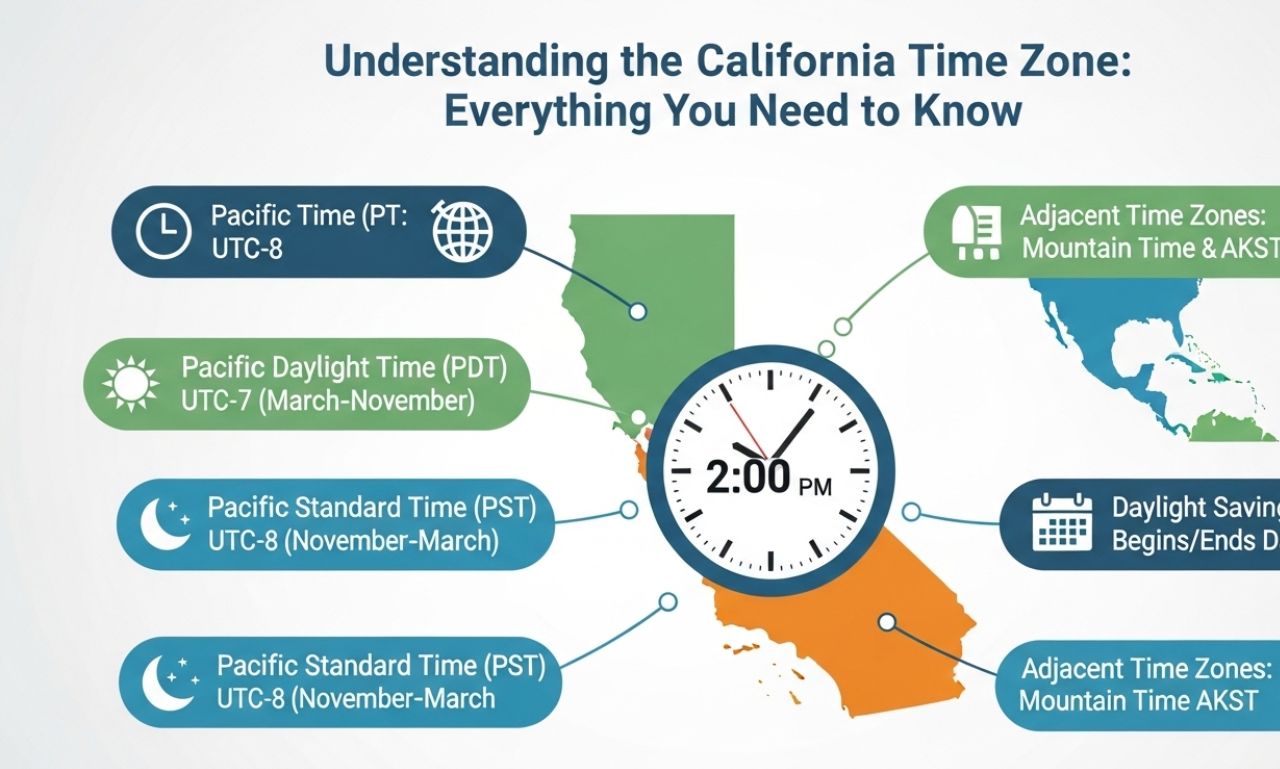
The California time zone plays a vital role in coordinating business, travel, entertainment, and daily life across the western United States. Whether you are planning a meeting with colleagues in Los Angeles, booking a flight to San Francisco, or streaming a live event from Silicon Valley, understanding the California time zone ensures you stay on schedule. This guide explores its structure, seasonal changes, historical background, and global significance in a clear and practical way.
What Is the California Time Zone?
The California time zone refers to the standard time observed throughout the state of California. The entire state follows the same time system, which is known as Pacific Time (PT). This includes both:
-
Pacific Standard Time (PST) – UTC −8 hours
-
Pacific Daylight Time (PDT) – UTC −7 hours
California shares this time zone with other western states such as Oregon and Washington. Major cities like Los Angeles, San Francisco, and San Diego all operate under the same clock.
The consistency of a single statewide time zone simplifies travel, commerce, and communication within California, which is the most populous state in the country.
The Role of Pacific Standard Time in the California Time Zone
Understanding Pacific Standard Time (PST)
Pacific Standard Time is observed during the fall and winter months. Under PST, the California time zone is eight hours behind Coordinated Universal Time (UTC−8). For example, when it is 4:00 PM in London (UTC), it is 8:00 AM in California during standard time.
PST generally begins in early November and continues until mid-March.
Understanding Pacific Daylight Time (PDT)
Pacific Daylight Time is used during the spring and summer months as part of daylight saving adjustments. During PDT, the California time zone shifts forward by one hour to UTC−7.
This change usually begins in March and ends in November. The purpose of daylight saving time is to make better use of evening daylight, which can benefit energy usage and outdoor activities.
Daylight Saving Time and the California Time Zone
Daylight Saving Time (DST) is a key feature of the Cali fornia time zone. Each year:
-
Clocks move forward one hour in March
-
Clocks move back one hour in November
This seasonal shift affects work schedules, school routines, travel plans, and even digital devices that automatically adjust.
There have been discussions within California about potentially ending the seasonal clock change, but as of now, the state continues to follow the federal daylight saving schedule.
Historical Background
Before standardized time zones were introduced in the late 19th century, cities set their clocks based on the position of the sun. This created confusion, especially for expanding railroad systems.
In 1883, American railroads introduced standardized time zones, including the Pacific Time Zone. Later, the U.S. government formalized the system. Since then, the Califo rnia tim e zon e has remained part of the Pacific Time framework.
California’s alignment with Pacific Time reflects its geographic location along the West Coast and its economic integration with neighboring states.
How the California Time Zone Impacts Business and Technology
California is home to major industries that influence global markets. The Califo rnia ti me zo ne affects how businesses coordinate with partners across the country and around the world.
Technology and Silicon Valley
Companies headquartered in San Jose and the broader Silicon Valley region operate within Pacific Time. Because California is three hours behind New York (Eastern Time), national meetings often occur earlier in the day for West Coast professionals.
For global communication, the Califo rnia ti me zon e can create challenges when working with Europe or Asia. However, many tech companies have adapted by offering flexible schedules and remote collaboration tools.
Entertainment Industry
The entertainment industry centered in Hollywood also operates according to Pacific Time. Television broadcasts often list showtimes in both Eastern and Pacific formats. Live award shows and events frequently adjust schedules to accommodate national audiences.
Comparing the California Time Zone to Other U.S. Time Zones
The United States has four primary continental time zones:
-
Pacific Time (California)
-
Mountain Time
-
Central Time
-
Eastern Time
Here’s how the California time zo ne compares:
-
3 hours behind Eastern Time
-
2 hours behind Central Time
-
1 hour behind Mountain Time
For example, when it is 9:00 AM in California, it is 12:00 PM in New York and 11:00 AM in Chicago.
This time difference plays a significant role in financial markets, as the New York Stock Exchange opens at 6:30 AM Pacific Time.
Travel and the California Time Zone
Domestic Travel
Travelers flying from the East Coast to California often experience jet lag due to the three-hour time difference. Adjusting sleep schedules before departure can help reduce fatigue.
Within the state itself, travelers do not need to adjust their clocks, as the Califor nia ti me zo ne remains consistent from north to south.
International Travel
California’s Pacific location makes it a major gateway for flights to Asia and Oceania. When flying west across the Pacific Ocean, travelers cross the International Date Line, which can significantly alter the calendar date.
Understanding the Cal ifornia ti me zo ne helps travelers manage layovers, arrival times, and connecting flights efficiently.
The Economic Importance of the California Time Zone
California has one of the largest economies in the world. The Califo rnia tim e zo ne plays a strategic role in allowing businesses to communicate with both Asia and the eastern United States within the same business day.
Morning hours in California overlap with afternoon hours in Europe. Meanwhile, late afternoon in California overlaps with morning in parts of Asia. This unique positioning enhances California’s global trade capabilities.
Financial markets, tech launches, and product announcements are often scheduled strategically to maximize national and international exposure.
Technology and Automatic Time Updates
Modern smartphones, computers, and smart devices automatically update to match the Calif ornia ti me zon e. These devices detect geographic location and adjust between PST and PDT without manual input.
However, mechanical clocks and older systems still require manual changes during daylight saving transitions. Missing the time change can lead to missed appointments or scheduling errors.
Common Questions About
Does All of California Follow the Same Time Zone?
Yes. Unlike some states that span multiple time zones, California operates entirely within Pacific Time.
Is the California Time Zone the Same as Nevada?
Most of Nevada follows Pacific Time as well, except for a small northeastern portion that observes Mountain Time.
Will California Eliminate Daylight Saving Time?
Although proposals have been discussed, no permanent change has been implemented. For now, the Califo rnia tim e zone continues to observe daylight saving adjustments.
Why the California Time Zone Matters Globally
The influence of California extends far beyond its borders. From technology innovation to entertainment and agriculture, the state’s activities affect international markets.
Because of this global reach, the Calif ornia tim e zone is frequently referenced in international scheduling, virtual conferences, and worldwide product releases.
For example, when a major tech company announces a new product at 10:00 AM Pacific Time, viewers across multiple continents convert from the California time zon e to their local time to watch live.
Final Thoughts
The Cal ifornia tim e zone is more than just a clock setting. It shapes business operations, travel planning, digital communications, and global commerce. Operating on Pacific Time, with seasonal shifts between PST and PDT, California remains synchronized with the broader West Coast while maintaining strong connections worldwide.
Understanding how the Cali fornia tim e zone works allows individuals and organizations to manage time differences effectively. Whether you are coordinating meetings, planning travel, or tracking financial markets, knowing the details of Pacific Time ensures accuracy and efficiency.
As California continues to influence technology, entertainment, and trade, its time zone will remain a critical element of daily life and global interaction.